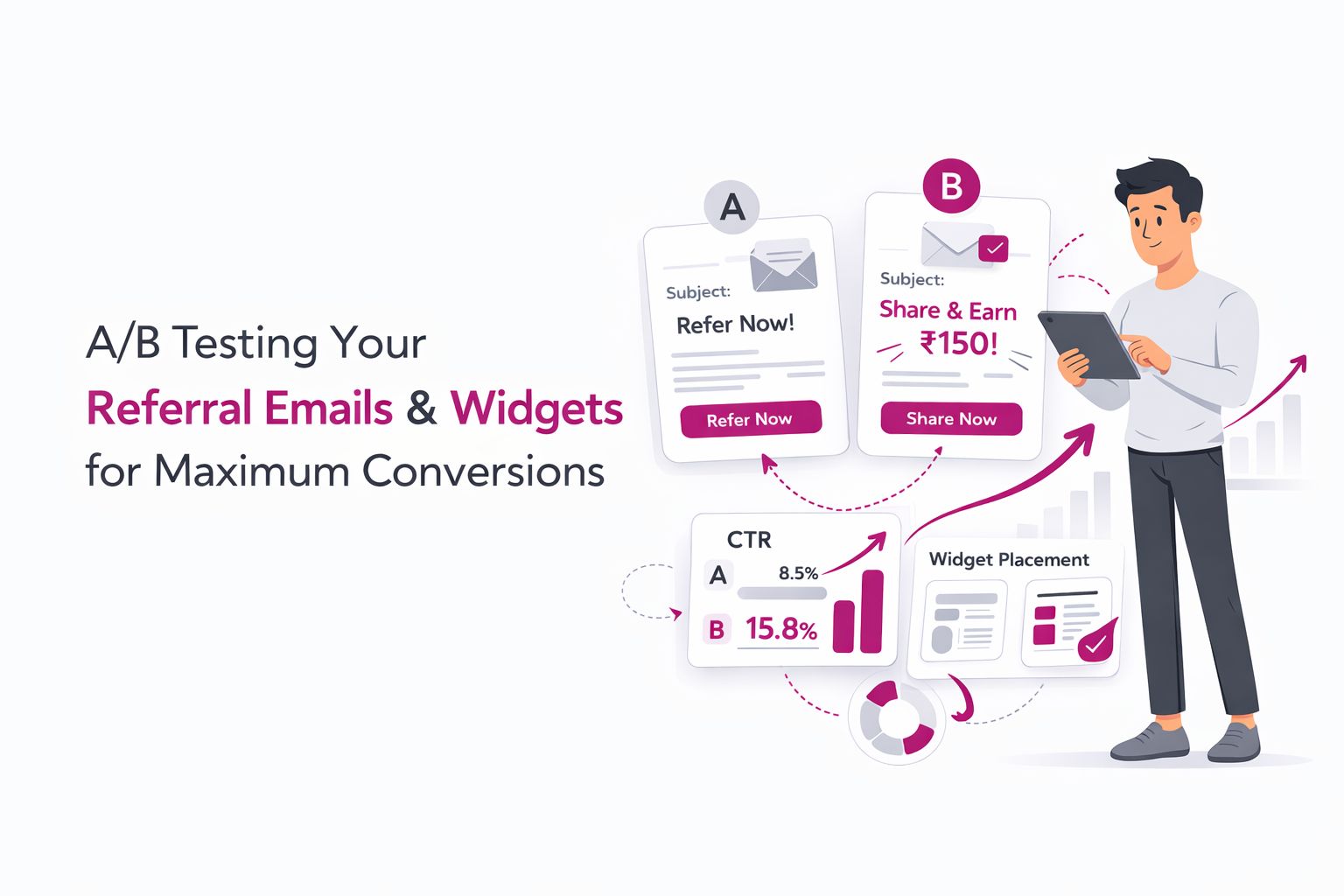
A/B testing is essential for refining every element of your referral program—from email subject lines to widget placement. By systematically comparing variations, you uncover what truly resonates with your audience and drives higher referral conversions. In this post, you’ll discover why A/B testing matters, how to set up effective experiments, and interpret results for ongoing growth.
1. Why A/B Testing Matters
- Data-Driven Decisions: Move beyond gut feel—use real metrics to guide copy, design, and incentive choices.
- Incremental Gains Compound: Small uplifts in email open or click rates translate to significant referral volume over time.
- Risk Mitigation: Test changes on a subset of users before rolling out sitewide.
Industry benchmarks show that companies running regular A/B tests can increase conversion rates by 15–20% year-over-year.
2. Setting Up Effective A/B Tests
A. Define Clear Hypotheses
Formulate a hypothesis like: “Changing the CTA from ‘Refer Now’ to ‘Share & Earn ₹150’ will increase clicks by 10%.”
B. Determine Your Variables
- Emails: Subject lines, preview text, body copy, button text, or send time.
- Widgets: Placement (thank-you page vs. dashboard), button color, headline copy, or incentive language.
C. Choose Your Metrics
- Primary Metric: Email open rate, click-through rate (CTR), or widget submission rate.
- Secondary Metrics: Referral conversion rate, unsubscribe rate, or bounce rate.
D. Tools & Platforms
- Email Platforms: HubSpot, Klaviyo, or Mailchimp.
- On-Site Testing: Optimizely, VWO, or built-in testing in your referral platform.
3. Executing Your A/B Tests
- Randomize Traffic: Ensure equal and random distribution across variants A and B.
- Run Simultaneously: Avoid seasonal biases by running variations at the same time.
- Change One Element: Isolate the impact by only changing one variable per test.
- Reach Significance: Wait until you reach the calculated sample size before concluding.
4. Analyzing A/B Test Results
- Statistical Significance: Aim for a confidence level of 95% before declaring a winner.
- Interpret Findings: If variant B outperforms A significantly, implement B. If neither wins, learn from the data and pivot your hypothesis.
- Qualitative Feedback: Supplement data with user surveys to understand why one variant performed better.
5. Real-World Examples
- Subject Line Test: A D2C brand tested “Give ₹100, Get ₹100” vs. “Refer & Earn Instantly!”. The latter achieved a 22% higher open rate.
- Placement Test: A retailer compared a pop-up vs. an inline dashboard widget. The inline version drove a 12% higher submission rate, indicating less intrusive UX worked better.
Conclusion
A/B testing your referral emails and widgets is the fastest path to discovering what truly motivates your customers. By following a structured testing framework—defining hypotheses, choosing metrics, and running rigorous experiments—you’ll unlock consistent, data-backed improvements in your referral conversion rates.