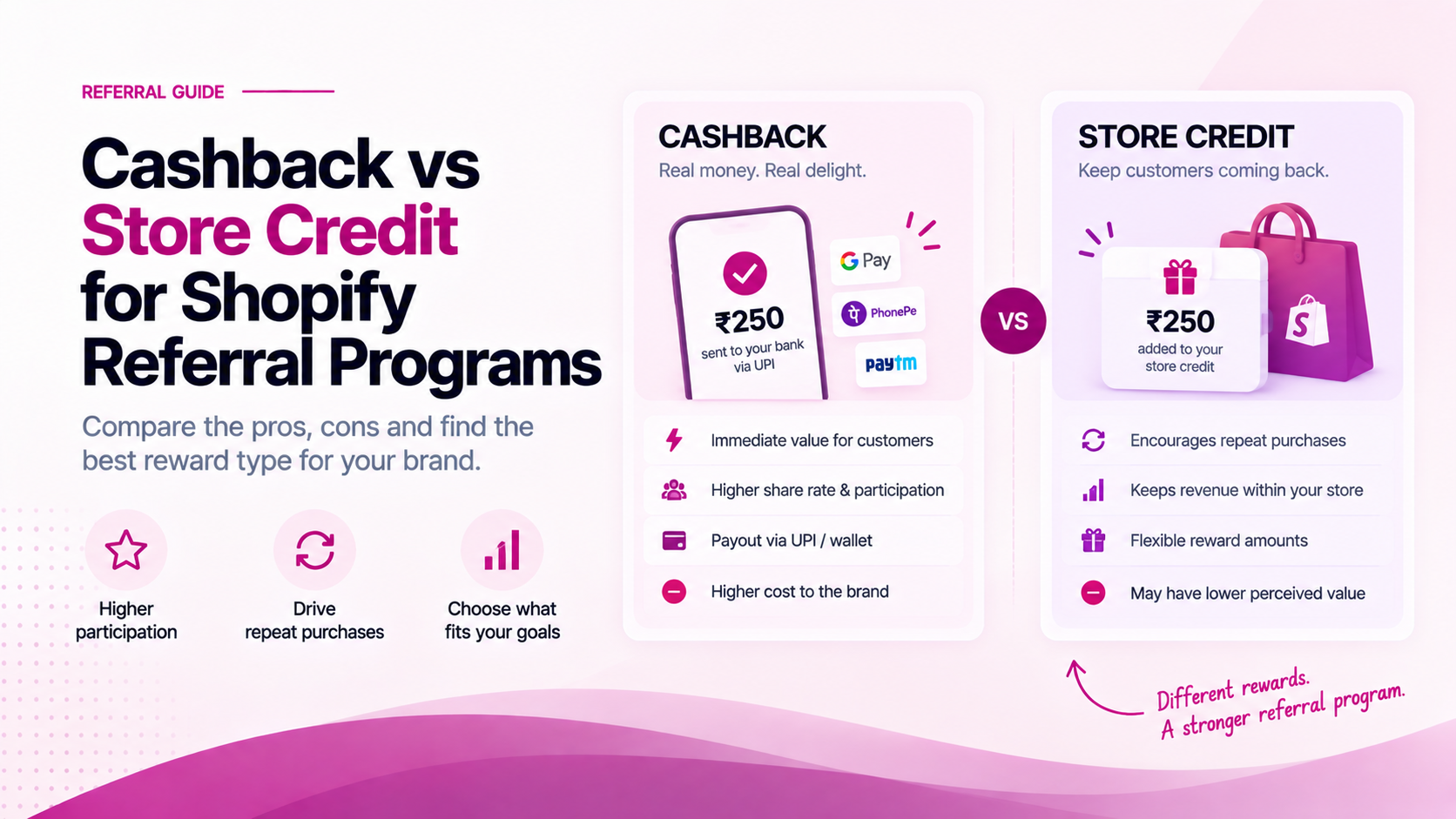
Cashback and store credit can both motivate customers to refer.
But they create different customer perceptions and different economics. Choosing between them should be a deliberate decision — not a default.
Cashback
Cashback is easy to understand.
"Refer a friend and get ₹100."
The customer knows exactly what they receive. There is no ambiguity about value.
The trade-off is that the reward leaves the brand. The ₹100 cashback is a real cash outflow — the customer can spend it anywhere.
Cashback may make sense when:
- Immediate, tangible value is important to your customer
- Customers are highly price-sensitive
- The reward must be simple enough to understand in a single line
- You want maximum motivational clarity
Store Credit
Store credit keeps the value inside the business.
"Refer a friend and get ₹150 store credit."
This can work well when repeat purchase is strong and customers are already engaged with the brand. A customer who regularly buys from you will treat ₹150 credit as near-cash.
The risk is that customers who do not have a strong repeat purchase habit may perceive store credit as less valuable than the equivalent cash amount — or may never redeem it at all.
Store credit may make sense when:
- Repeat purchase rate is healthy
- The brand wants to encourage another order
- Retaining reward value inside the store is economically attractive
- You are comfortable with unredeemed credit as a liability on your books
Compare Economic Cost — Not Just Face Value
The comparison is not always ₹100 cashback vs ₹100 store credit.
Suppose you offer:
| Reward type | Face value | Economic cost |
|---|---|---|
| Cashback | ₹100 | ₹100 (paid out in cash) |
| Store credit | ₹150 | Less than ₹150 if some credit is not redeemed |
Store credit with a higher nominal value can sometimes cost the merchant less in actual economic terms, because not all credit is spent, and those that do spend create another order. The relationship between face value and economic cost is not 1:1.
Work through this calculation for your own redemption and repeat purchase data — the right answer depends on your specific numbers.
Ask What Behaviour You Want to Drive
The reward type should follow from the behaviour you are trying to create:
- If you want one-time advocates to share, cashback may be more motivating
- If you want repeat buyers to become advocates, store credit can reinforce the loop
- If you want to test both, Referbro supports cashback, store credit, discounts and gifts — you can run different offers for different segments or time periods
What to Track
Run the comparison against these metrics before concluding which reward works better:
- Share rate — are customers willing to share under each structure?
- Referral conversion — are referred friends completing the purchase?
- Reward redemption rate — especially important for store credit
- Repeat purchase rate — do customers who earn store credit return?
- Referral CAC — true cost of acquiring a customer under each model
- Contribution after reward — net economics per referred order
Don't assume the reward with the highest nominal value will win. The best reward is the one that creates profitable incremental behaviour at a cost you can sustain.
Build Your Offer Structure
Referbro's Referral Offer Generator can help create offer structures based on your category and AOV — including cashback, store credit and hybrid options.
Related Articles
- How Much Should You Pay Customers for a Shopify Referral?
- Crafting Irresistible Referral Incentives
- How to Calculate Referral CAC for a Shopify Store
Learn more about Referbro Referral | Install Referbro on Shopify