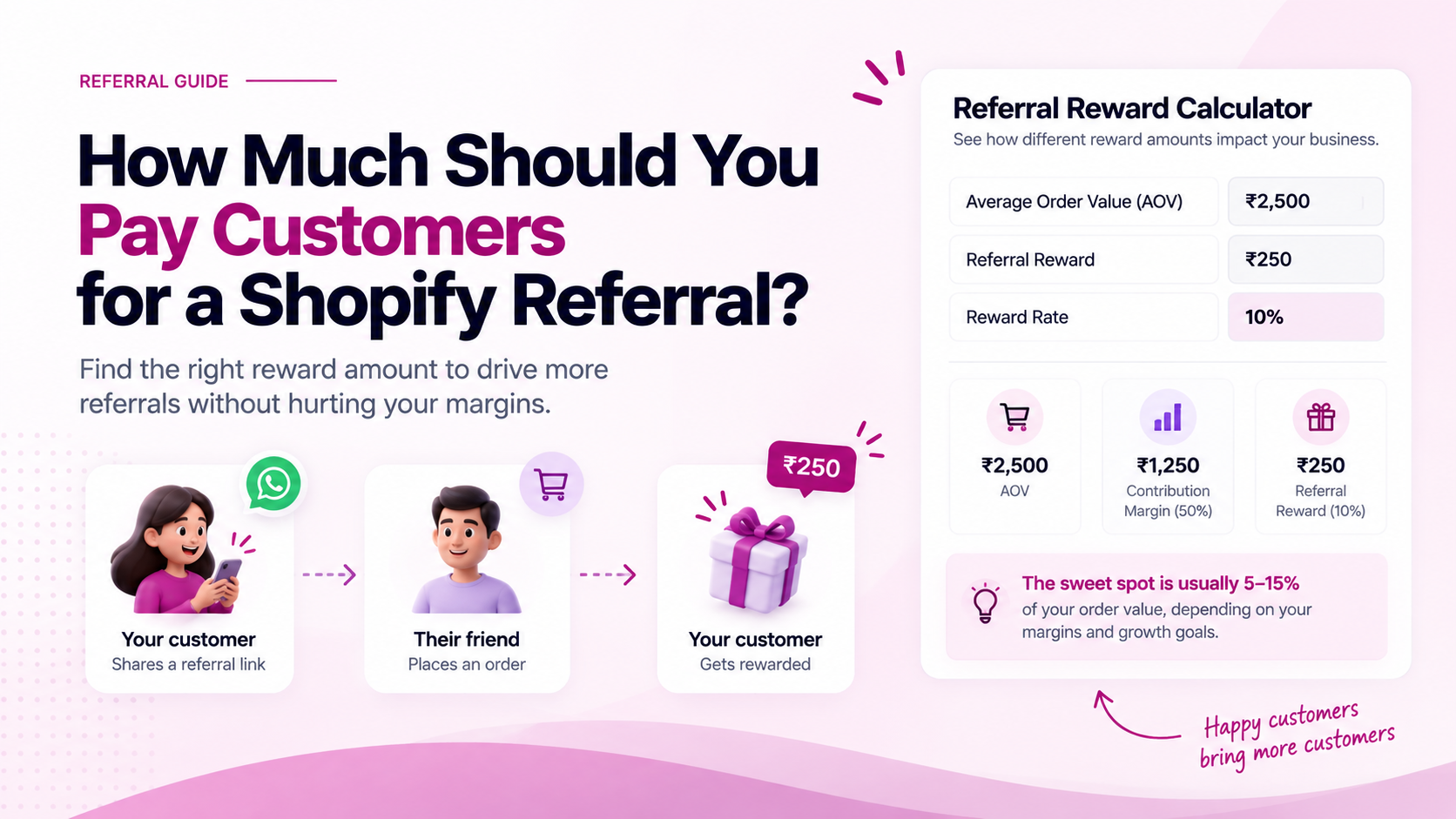
There is no universal "correct" referral reward.
₹50 may be too low for one brand and unnecessarily high for another. ₹200 may be attractive for a high-margin brand and destructive for a low-margin one.
The right reward depends on the economics of the referred order.
Start with Contribution
Before choosing a reward value, understand what a referred order actually contributes.
Suppose:
- AOV = ₹2,000
- Contribution before referral reward = ₹700
Against that, you could test:
- ₹75 reward
- ₹100 reward
- ₹150 reward
The decision should not be based on what feels generous. Ask: how much additional referral behaviour does each reward level actually create?
There Are Two Sides to the Offer
A referral program typically has two parts:
- Referrer reward — the incentive for the existing customer who shares
- Friend incentive — the reason for the new customer to complete the purchase
The friend needs a reason to complete the purchase. The existing customer needs a reason to share. The exact structure should fit the brand's margin and purchase frequency.
A single-sided program rewards only one party. A double-sided program rewards both. Neither is universally better — the right structure depends on your economics and what motivates each audience.
Reward Incremental Behaviour
The biggest mistake in referral reward design is paying rewards for orders that would have happened anyway.
Use guardrails to protect your program:
- Unique referral links — track each share to a specific referrer
- Qualifying-order rules — define what counts as a valid referred purchase
- Return-window approval — wait until the return period has passed before releasing rewards
- Self-referral protection — prevent customers from using their own link
- Reward limits — cap the total rewards any one customer can earn
Then compare referred customers against your other acquisition channels using consistent metrics.
Start Simple
Don't launch with five reward tiers immediately.
Start with one clear offer. Measure:
| Metric | What it tells you |
|---|---|
| Share rate | Are customers willing to recommend? |
| Click rate | Is the friend offer compelling? |
| Referred conversion | Does the program produce orders? |
| Referral CAC | What is the real cost per acquired customer? |
| AOV | Are referred customers buying at expected values? |
| Repeat purchase | Are referred customers worth acquiring long-term? |
Then test the reward based on what the data shows — not on assumptions.
Test the Economics
Once you have baseline data, you can run structured tests:
- ₹100 vs ₹150 reward
- Cashback vs store credit
- Single-sided vs double-sided program
- Fixed reward vs percentage reward
Change one major variable at a time. Otherwise, you cannot isolate which change produced the result.
Use a Calculator Before You Commit
Referbro's Referral ROI Calculator can help model the economics before a program is launched or a reward is changed.
The goal isn't to offer the biggest reward.
It is to offer the smallest reward that creates meaningful incremental behaviour at a cost your margins can sustain.
Related Articles
- Cashback vs Store Credit for Shopify Referral Programs
- How to Calculate Referral CAC for a Shopify Store
- Referral Program Benchmarks for Shopify Stores
Learn more about Referbro Referral | Install Referbro on Shopify