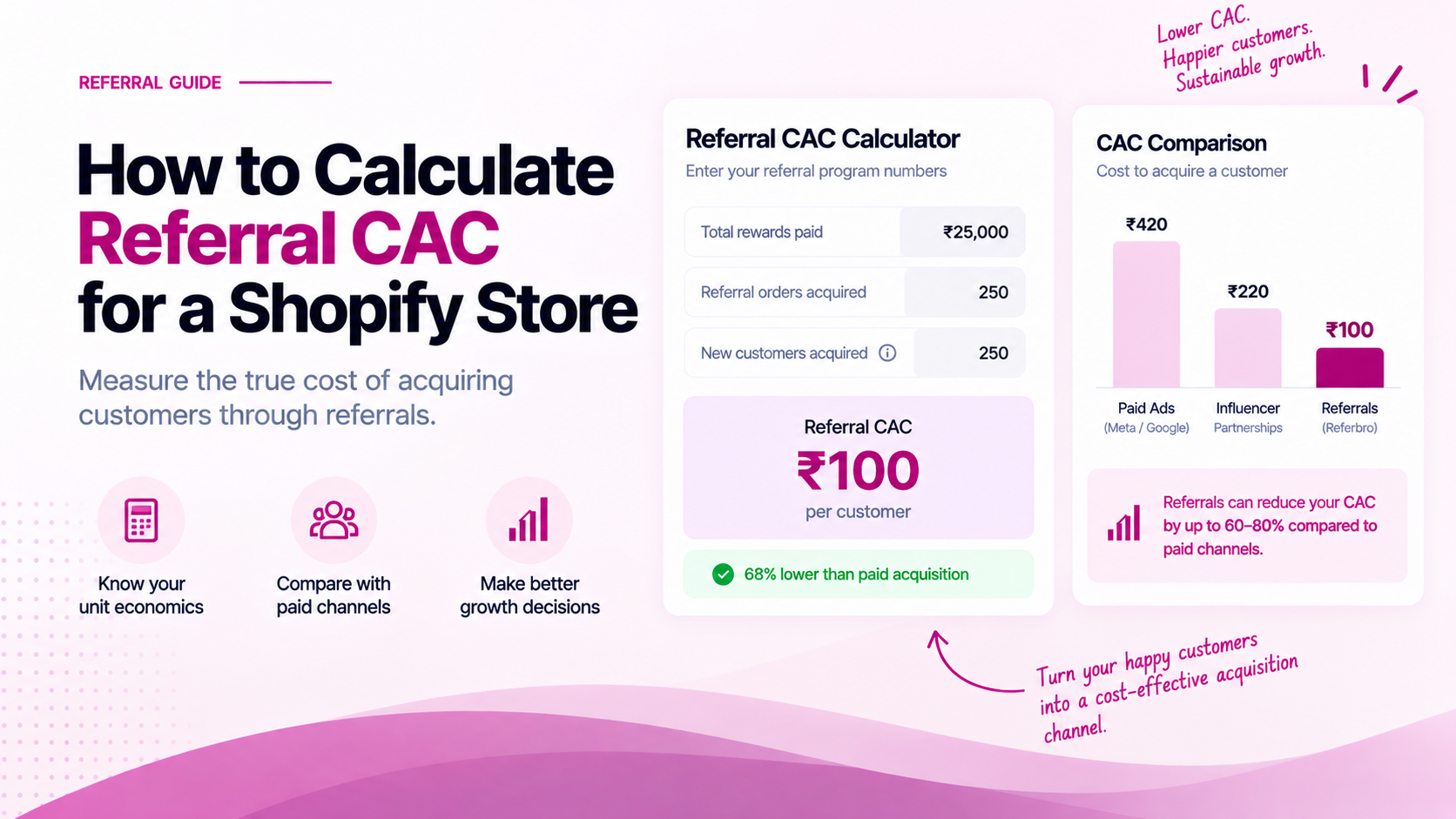
Referral CAC is the cost of acquiring a customer through a referral program.
The formula looks simple:
Referral CAC = referral program cost ÷ qualifying referred customers
The difficult part is defining both sides correctly — and understanding what the number actually means once you have it.
What Belongs in Referral Program Cost?
Depending on your accounting model, include:
- Referrer rewards — the cashback, credit or discount paid to the customer who shared
- Friend discounts — the incentive applied to the referred friend's order
- Payout fees — payment processor or bank transfer costs for cashback
- Referral software cost — your monthly platform fee, prorated to the period
- Campaign costs — any spend on promoting the program (WhatsApp blasts, email)
Use a consistent definition when comparing referral against paid channels. If paid social CAC includes only media spend but referral CAC includes rewards, discounts and software, the comparison is not useful. Define the cost boundary first.
A Worked Example
Suppose:
| Input | Value |
|---|---|
| Qualifying referred orders in the month | 500 |
| Average referrer reward per order | ₹100 |
| Average friend discount per order | ₹50 |
| Total incentive cost | ₹75,000 |
| Software cost (monthly, prorated) | ₹5,000 |
| Total referral program cost | ₹80,000 |
Referral CAC = ₹80,000 ÷ 500 = ₹160
That number is a starting point — not a conclusion. The next question matters more.
Incrementality Changes the Calculation
Those 500 referred orders are not automatically 500 incremental customers.
Suppose 100 of those customers would have found the brand and purchased anyway through organic or direct channels. The program may have created only 400 genuinely new customers — which means the effective referral CAC is higher than ₹160 on an incremental basis.
This is not a failure of the program. It is the correct way to measure it.
The question is not "how many orders came through the referral link?" — it is "how many of those orders would not have happened without the program?"
To estimate incrementality, compare:
- Referral traffic vs baseline conversion
- Referred customer behaviour vs non-referred new customers
- New customer share among referred orders
- Direct or paid channel overlap
- Returning-customer rate within referred orders
You may not be able to measure incrementality perfectly. But looking at the signals will tell you whether your referral CAC is closer to ₹160 or ₹300 on a true incremental basis.
Compare Apples with Apples
When benchmarking referral CAC against paid channels, use the same cost definition. A useful comparison includes:
| Metric | Referral | Paid Social |
|---|---|---|
| CAC | ₹160 | ₹220 |
| First-order contribution | Model for your data | Model for your data |
| 90-day contribution | — | — |
| Repeat purchase rate | — | — |
| Payback period | — | — |
The CAC number alone is not enough. A ₹75 referral CAC bringing low-value, one-time customers may be worse than a ₹150 CAC bringing customers with strong repeat behaviour. The real target is profitable incremental customers.
Optimise the Right Number
Once you have referral CAC and a contribution baseline, you can model what happens if you:
- Increase the referrer reward
- Add a friend discount
- Change the qualifying-order rules
- Reduce the program's software cost
- Improve share rate through better UX placement
Each change shifts both sides of the equation.
Referbro's Referral ROI Calculator can help model reward cost and referral economics before changing the program structure.
Related Articles
- How Much Should You Pay Customers for a Shopify Referral?
- Calculating the True ROI of Your Referral Program
- Referral Program Benchmarks for Shopify Stores
Learn more about Referbro Referral | Install Referbro on Shopify