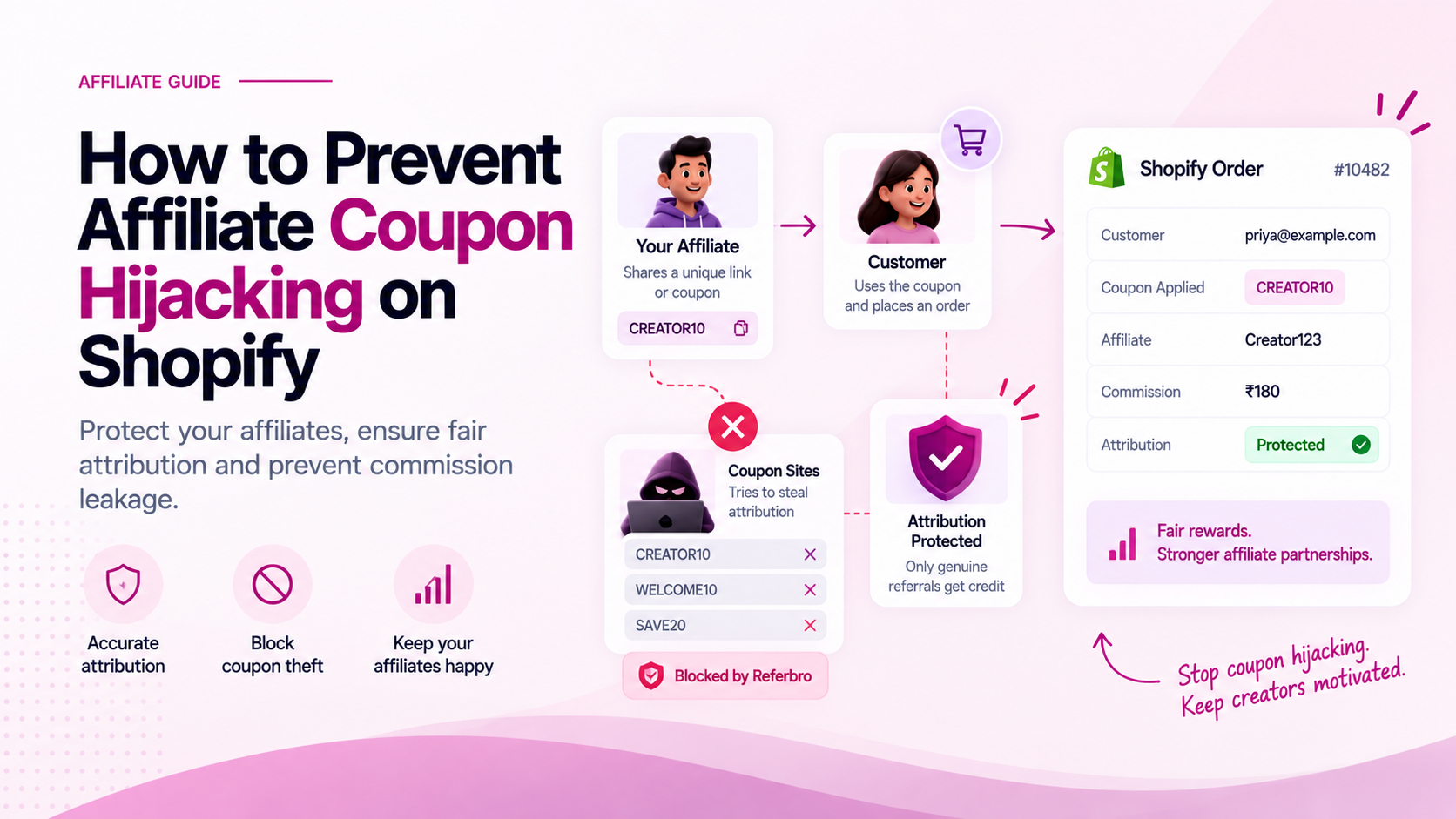
Affiliate coupon hijacking is an attribution problem — not always straightforward fraud.
The customer may have discovered the brand through organic search, paid ads, social content or direct traffic. Then, just before checkout, they search for a coupon code. If an affiliate coupon is publicly available — on a coupon aggregator site or shared beyond the intended creator audience — that affiliate may receive commission credit for demand they did not create.
The merchant pays an acquisition cost for a customer who was already going to buy.
How the Problem Appears
Hijacking is often invisible until you look at the data. Common signals include:
| Signal | What to investigate |
|---|---|
| High coupon-driven conversion rate | Is the code reaching an audience the affiliate did not introduce? |
| Unusually low new-customer rate | Is the affiliate mostly capturing existing customers? |
| Orders concentrated near checkout (very short session length) | Is traffic coming in with the intent to use a code, not to discover? |
| Exposure on coupon aggregator sites | Has the code been posted publicly beyond the creator's channel? |
| Sudden commission spikes without a matching content launch | What caused the volume increase? |
| Repeated code use by customers with order history | Are existing customers using the code for a discount on an order they would have placed anyway? |
None of these signals proves abuse in isolation. They indicate that attribution needs investigation — not automatic commission reversal.
Separate Discovery from Capture
The useful conceptual distinction is:
- Did the affiliate introduce the customer to the brand? (Discovery)
- Or did the affiliate simply capture the customer at the final checkout step? (Capture)
A creator who publishes genuine content that reaches a new audience is doing discovery. A coupon aggregator listing a code that appears in a last-second search is doing capture.
This distinction is difficult to measure perfectly — most Shopify analytics are last-click by default. But combining multiple signals (session length, new vs returning customer status, referral path, code usage patterns) gives a more complete picture.
Use Both Link and Coupon Attribution
Using affiliate links and coupon codes in combination provides more evidence than either alone.
- Affiliate links — create a trackable referral path from the partner's content to the Shopify session
- Coupon codes — capture sales from offline or dark-social content where links cannot be tracked
When both a link and a code are present, you have stronger evidence of genuine attribution. When only a code is present and the session was very short with no referral path, that is a signal worth investigating.
Referbro Affiliate supports link and coupon attribution and real-time conversion tracking.
Define Attribution Rules Before Recruiting Partners
Attribution disputes are easier to prevent than to resolve. Before the first partner goes live, document:
- Attribution window — how long after a click does an affiliate earn credit for a sale?
- Coupon priority — if a code is used without a tracked link, does the code win? What if the code and link are from different affiliates?
- New vs existing customer rules — does the programme pay commission on existing customers converting with a code?
- Commission approval timing — when does a commission become payable? Immediately, or after a return window?
- Return handling — what happens to an approved commission if the customer returns after the approval date?
- Overlapping affiliate touchpoints — how is credit split when two affiliates influenced the same customer?
Write these rules into the partner agreement before launch. Partners who disagree with the rules can decline to participate before they have earned and expected commissions under a different assumption.
Audit Partners with Unusual Patterns
Periodically review partner performance for:
- Very high conversion rate with very low click volume
- High share of existing-customer orders relative to new customers
- Sudden coupon-site exposure with no content launch
- Unusual order velocity in short time windows
- Code usage patterns that do not match the creator's stated audience
The objective is not to find a reason to remove partners. It is to distinguish partners creating incremental demand from those primarily intercepting customers who were already in-market.
Protect the Economics Without Punishing Partners
The goal of coupon hijacking controls is not to punish affiliates.
It is to pay commission for incremental distribution — not for last-click capture of demand that existed independently of the partner.
A clean programme design:
- Uses unique codes per partner (or partner plus campaign)
- Combines link tracking with code tracking where possible
- Has clear attribution rules agreed before launch
- Audits unusual patterns before increasing commissions
- Does not expose codes in publicly searchable locations unless the business case supports it
Referbro's fraud controls are designed to detect suspicious patterns and protect the merchant's commission economics while maintaining fair treatment for genuine creator partners.
Related Articles
- How to Set Shopify Affiliate Commission Rates by Product Margin
- When Should a Shopify Store Start an Affiliate Program?
- Referral vs Affiliate Marketing: Key Differences Explained
Learn more about Referbro Affiliate | Install Referbro on Shopify