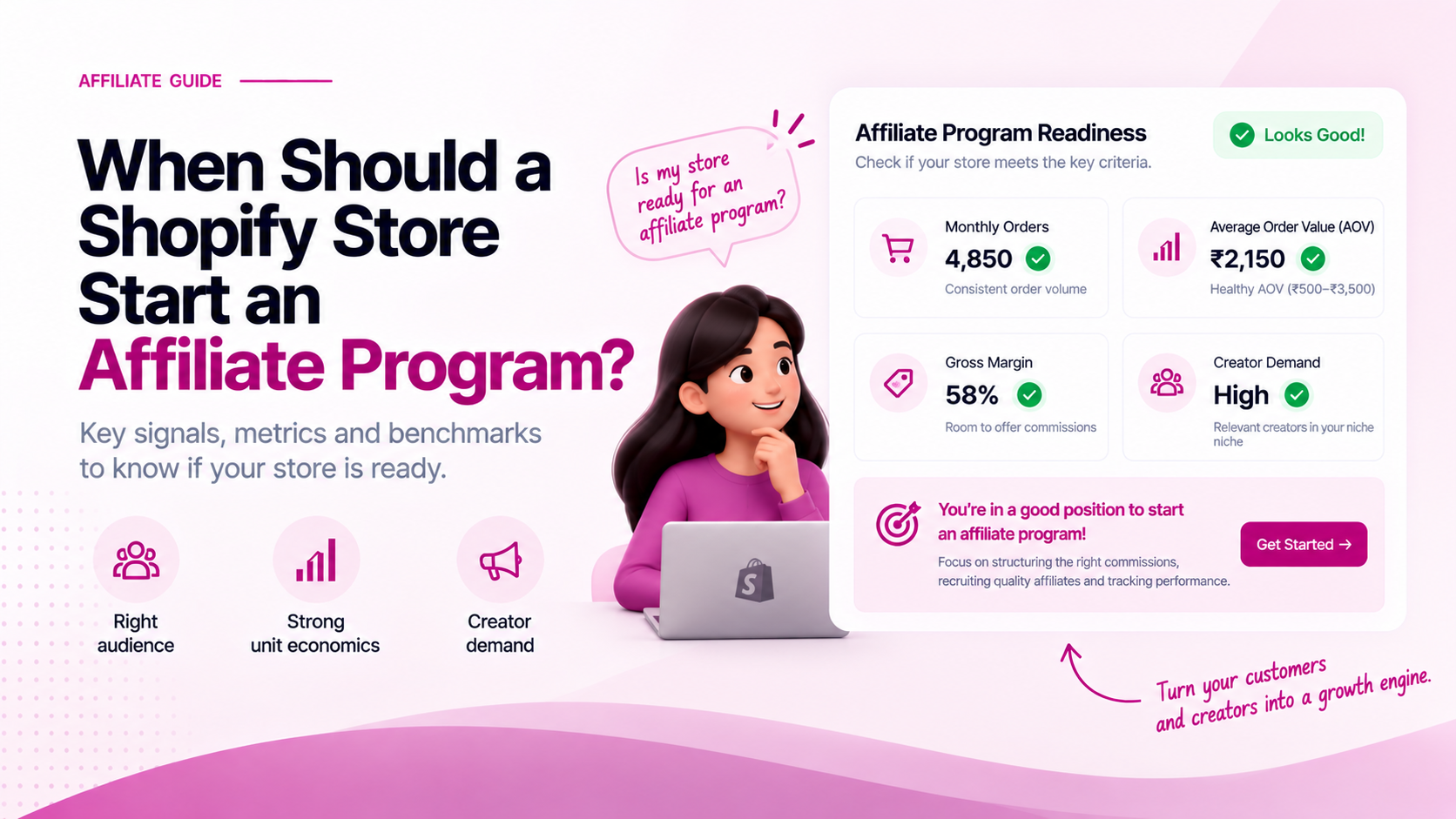
An affiliate programme is not automatically the next step after paid ads.
It works when there are partners who can create incremental demand — and when the economics support paying them a commission for doing so.
Look for Partner Fit Before Platform
The most common mistake is setting up an affiliate platform before confirming that there is a creator market for the product.
Ask these questions first:
- Do creators already talk about this product or this category?
- Do customers ask where to get recommendations before buying?
- Is there a recognisable type of creator whose audience overlaps with the buyer?
- Can the product be credibly demonstrated, reviewed or recommended in content?
If the answer to most of these is no, an affiliate platform will not manufacture creator-market fit by itself. Recruiting creators before there is a natural alignment between the product and the audience usually produces low conversion rates and high commission spend for little incremental return.
Check the Margin Before Setting Commission
Affiliate commission is a variable acquisition cost. It is paid per sale, which is attractive — but it must fit within the product economics.
Start with contribution margin.
Suppose:
| Input | Value |
|---|---|
| AOV | ₹2,000 |
| Contribution before affiliate commission | ₹800 |
| Commission at 10% | ₹200 |
| Contribution after commission | ₹600 |
That ₹600 remaining contribution may be attractive or unattractive depending on:
- Repeat purchase — does this customer generate further revenue?
- Incrementality — would they have purchased without the affiliate?
- Other acquisition costs — are there additional costs attached to this channel?
Run the same calculation for your lowest-margin products. A flat 10% rate that works for one SKU may be destructive for another.
Define Attribution Before You Recruit Partners
Attribution disputes are the most common source of friction in affiliate programmes.
Before recruiting the first partner, document:
- What counts as a qualifying sale? — first-time customer only, or any customer?
- How long is the attribution window? — 7 days, 30 days, or another period?
- Do coupon codes count independently of a click? — if a code is used without a tracked link, does the affiliate get credit?
- What happens when paid search gets the last click? — which source takes priority?
- What happens when two affiliates influenced the same customer? — first-click, last-click, or split?
A programme without clear attribution rules creates disputes with partners and confusion internally. Define the rules before they become a problem.
Start with a Small Pilot Group
Recruit a small number of genuinely relevant partners before scaling.
Measure the pilot against:
| Metric | What it tells you |
|---|---|
| Clicks per affiliate | Is the partner reaching a real audience? |
| Conversion rate | Is the audience commercially relevant? |
| AOV | Are affiliate customers buying at expected values? |
| New customer rate | Are the affiliate bringing genuinely new buyers? |
| Commission as % of revenue | Is the cost sustainable? |
| Repeat purchase rate | Do affiliate-acquired customers come back? |
| Refund rate | Is the partner traffic commercially healthy? |
Only scale the programme if the pilot shows that affiliate can create incremental customers at an economics that works. A programme that produces volume without incrementality is expensive market share redistribution.
Watch for Coupon Leakage from Day One
Affiliate codes have a tendency to travel beyond the intended creator audience.
A code that appears on a coupon aggregator site may capture customers who were already going to buy — producing commissions for demand the affiliate did not create.
Your programme needs both attribution tracking and fraud controls from launch. Referbro Affiliate supports self-serve partner onboarding, custom commission tiers, link and coupon attribution, conversion tracking and fraud controls.
The Right Time to Launch
The right time to start an affiliate programme is when:
- There is a demonstrable creator audience that overlaps with your buyer
- Product economics support the commission without damaging contribution
- Attribution rules are defined before partners are recruited
- You have the operational capacity to onboard, track and pay partners consistently
The programme that fails most often is the one launched because a competitor has one — not because the economics and audience fit were verified first.
Related Articles
- Referral vs Affiliate Marketing: Key Differences Explained
- How to Set Shopify Affiliate Commission Rates by Product Margin
- How to Prevent Affiliate Coupon Hijacking on Shopify
Learn more about Referbro Affiliate | Install Referbro on Shopify