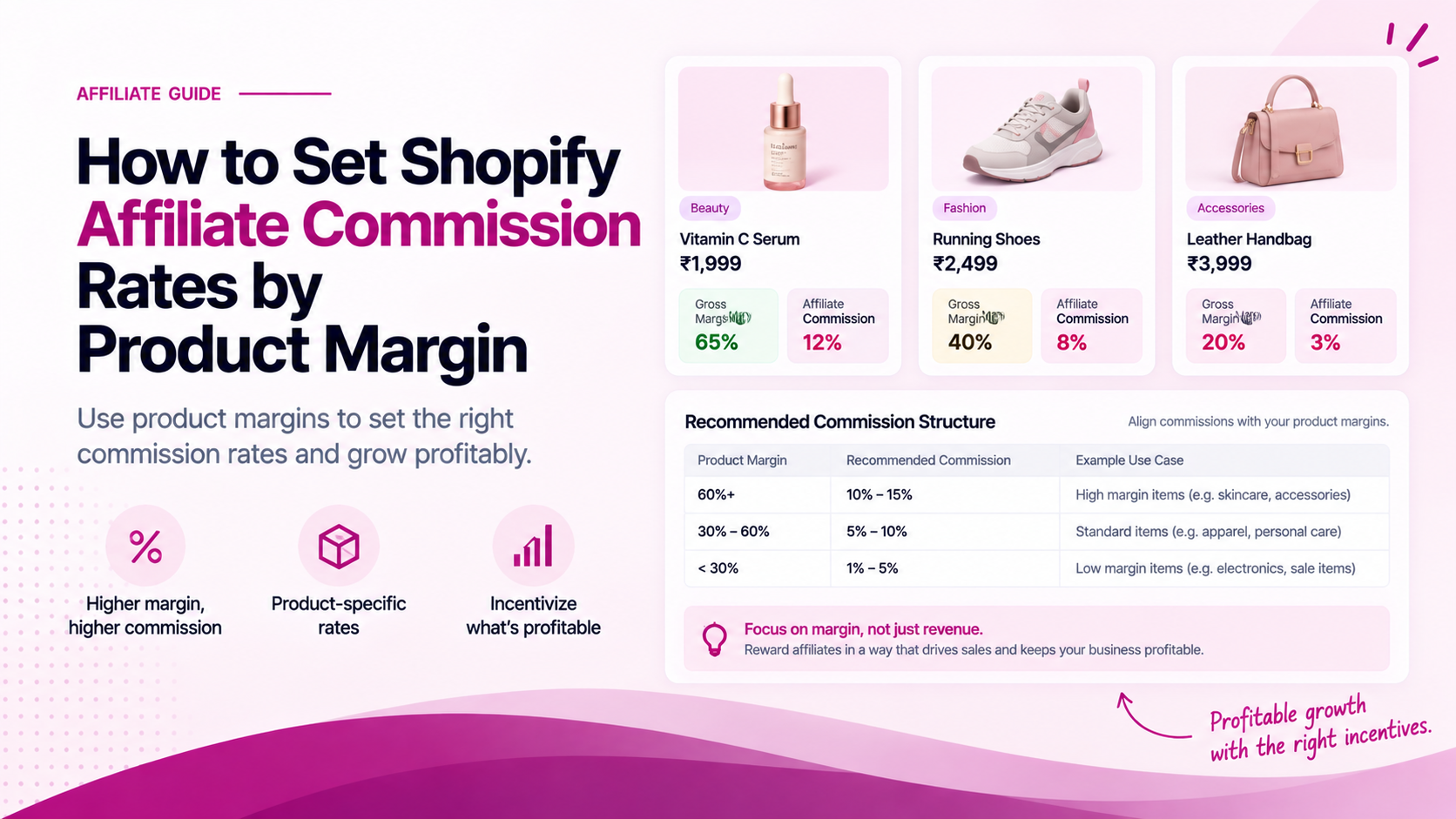
The easiest way to set an affiliate commission is to copy another brand's percentage.
It is also one of the easiest ways to damage your margins — because their product economics and yours are almost certainly different.
A better approach is to start with the contribution each product actually generates, and build commission bands around that.
Start with Contribution Per Product
Before setting any commission, calculate the contribution a product makes before the affiliate cost.
Suppose:
| Input | Value |
|---|---|
| Selling price | ₹2,000 |
| Product cost + variable costs | ₹1,000 |
| Contribution before commission | ₹1,000 |
| Commission at 10% | ₹200 |
| Contribution after commission | ₹800 |
Now apply the same logic to a lower-margin product:
| Input | Value |
|---|---|
| Selling price | ₹2,000 |
| Product cost + variable costs | ₹1,500 |
| Contribution before commission | ₹500 |
| Commission at 10% | ₹200 |
| Contribution after commission | ₹300 |
The same 10% rate has a very different effect. On the first product, the contribution remains healthy. On the second, a 10% commission represents 40% of the available margin before other costs.
This is why a flat percentage applied across all products is rarely the right structure.
Build Commission Bands by Margin
Once you have contribution data for your key products, group them into bands:
| Band | Contribution before commission | Commission ceiling |
|---|---|---|
| High margin | ₹800+ | Higher rate — room to be competitive |
| Medium margin | ₹400–₹799 | Standard rate |
| Low margin | Below ₹400 | Lower rate or excluded from the programme |
These are planning principles, not universal percentages. The correct thresholds depend on your specific cost structure.
Some brands exclude certain SKUs from affiliate eligibility entirely — particularly clearance lines, already-discounted products or items where the contribution cannot support an additional acquisition cost.
Consider Partner Quality Separately from Rate
Not every affiliate should receive the same commission.
A creator who consistently brings genuinely new customers with strong purchase intent may justify a higher rate — because they are creating real incremental demand. A partner who drives mostly coupon-site traffic or existing customers converting at a discount is not creating the same value, even if they generate a similar order volume.
Commission should reflect incremental value — not just order count.
When thinking about partner tiers:
- New partner rate — a conservative rate while you assess the partner's traffic quality and incrementality
- Standard partner rate — the default for established partners performing within expected parameters
- High-performing partner rate — a higher ceiling for partners who demonstrably create new customers and strong revenue
Referbro Affiliate supports custom commission structures by partner or group, so these tiers can be configured without a single universal percentage.
Account for Returns Before Approving Commission
If commissions are approved immediately on order, returned purchases create payout leakage.
The customer buys. The affiliate earns the commission. The customer returns. The affiliate keeps the commission.
To prevent this:
- Define when a commission becomes payable — for example, after the return window has closed
- Match commission approval timing to your return policy — a 14-day return policy suggests approving after day 15
- Set return handling rules — what happens to an approved commission when a return occurs after the fact?
Defining these rules before launch prevents disputes with partners who expect immediate payment.
Model the Economics Before Going Live
Referbro's Affiliate Commission Planner lets you model what different commission rates and partner tier mixes do to your total commission spend and contribution — before you commit to a programme structure.
The best commission rate is not the highest one.
It is the highest rate you can sustain given the contribution margin of the products, the quality of the partner audience, and the incremental demand the programme actually creates.
Related Articles
- When Should a Shopify Store Start an Affiliate Program?
- How to Prevent Affiliate Coupon Hijacking on Shopify
- Referral vs Affiliate Marketing: Key Differences Explained
Learn more about Referbro Affiliate | Install Referbro on Shopify