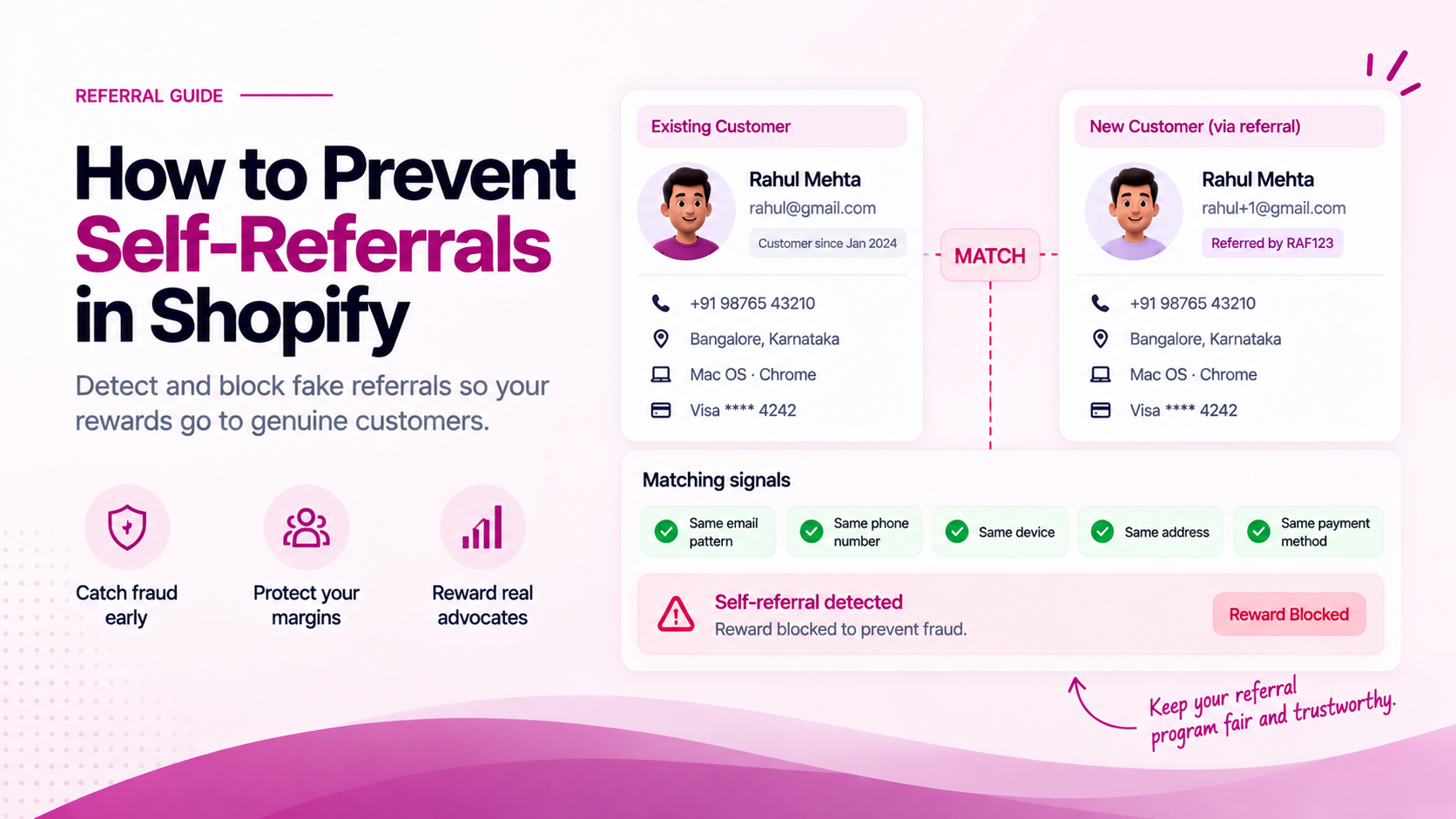
A referral program should reward a customer for bringing someone new.
The moment customers can reward themselves, the economics change. Self-referral abuse means you pay acquisition costs for customers who were already yours — or never existed at all.
What Self-Referral Abuse Usually Looks Like
The most common patterns are:
- A customer creates a second account and uses their own referral link to claim both sides of the incentive
- A customer shares the link within the same household to collect rewards for a purchase that was always going to happen
- A customer uses multiple email addresses or devices to generate repeated referral credits
The order may look entirely normal in Shopify. The acquisition is not.
Start with Clear Eligibility Rules
The most effective first control is to define what counts as a qualifying referral before abuse becomes a problem.
For example:
- New customer only — the referee must have no prior order history in Shopify
- Minimum order value — referred orders below a threshold do not qualify for the reward
- No previous order — the referred email must not exist in your customer database
- Return window completed — reward is approved only after the cancellation and return period has passed
- One reward per referred customer — a referrer cannot collect multiple rewards from the same person
The exact rules should match the business model. A subscription brand may define eligibility differently from a single-purchase brand.
Use Identity Signals Carefully
Referral platforms can use a combination of signals to identify suspicious patterns:
| Signal | What it indicates |
|---|---|
| Customer account | Is the referee a genuinely new account? |
| Email address | Does it match an existing customer? |
| Phone number | Is the number already in the system? |
| Order history | Has this person purchased before? |
| Device | Is the same device associated with multiple referral accounts? |
| IP address | Are multiple accounts sharing the same network? |
| Referral relationship | Is the referrer and referee unusually close in account creation time? |
No single signal is definitive. The goal is to identify suspicious patterns without blocking legitimate households, shared devices, or genuine friends who happen to share a network.
Delay Reward Approval
One of the safest operational controls is to approve rewards after the relevant cancellation or return window has closed.
This prevents the programme from paying out immediately on orders that later disappear. A customer who places and then cancels an order cannot collect a reward that has not yet been released.
Delaying approval by 7–14 days (or matching your return policy) significantly reduces the risk of paying for self-referrals that use the return window as an exploit.
Watch for Patterns, Not Just Individual Orders
Investigate when you see:
- The same device associated with many different referral accounts
- The same payment method or identity pattern across referrer and referee accounts
- Rapid, repeated claims in a short period from a single referrer
- A referrer and referee with obviously similar account details (name, address, phone)
- Multiple rewards being linked to the same household based on shipping address
These are signals that warrant investigation — not automatic disqualification. Legitimate families and businesses do sometimes share devices and addresses.
Don't Make the Programme Painful for Genuine Customers
Fraud controls have a cost: friction.
If self-referral protections create too much friction for legitimate customers, share rate will fall and the programme becomes less effective.
The design objective is:
Low friction for genuine sharing. High friction for abuse.
Referbro's referral product includes self-referral protection and duplicate-pattern detection designed to protect referral economics without blocking legitimate customer behaviour.
Related Articles
- Troubleshooting Common Referral Pitfalls
- Measuring the True Impact of Customer Referrals
- How to Calculate Referral CAC for a Shopify Store
Learn more about Referbro Referral | Install Referbro on Shopify