Referral programs can be a powerful engine for customer acquisition, but how do you know if your program is performing well? The key is understanding “referral rate” benchmarks—industry-standard conversion rates that indicate what constitutes good performance—and then plugging your own numbers into a referral ROI calculator. In this article, you’ll learn:
- What referral rate is and how to calculate it
- Typical referral rate benchmarks across D2C verticals
- How to measure and interpret your own program’s results
- Proven tips to improve your referral conversion rates
For the full list of referral program metrics and how to calculate referral program ROI, see our companion guides.
What is referral rate, and why does it matter?
Referral rate is the share of your orders that come from referred customers. It’s calculated as:
Referral Rate (%) = (Orders from Referred Customers ÷ Total Orders) × 100
Two related metrics explain what drives it: the share rate (the % of customers who share their referral link) and the referral conversion rate (the % of friends who receive a link and buy).
A high referral rate indicates that your program’s incentives, UX, and messaging resonate with customers. Monitoring this metric helps you:
- Gauge the effectiveness of your incentives (cashback, discounts, store credits)
- Identify friction points in your referral UX (widgets, landing pages, sharing channels)
- Benchmark performance against industry standards
What is a good referral rate by industry?
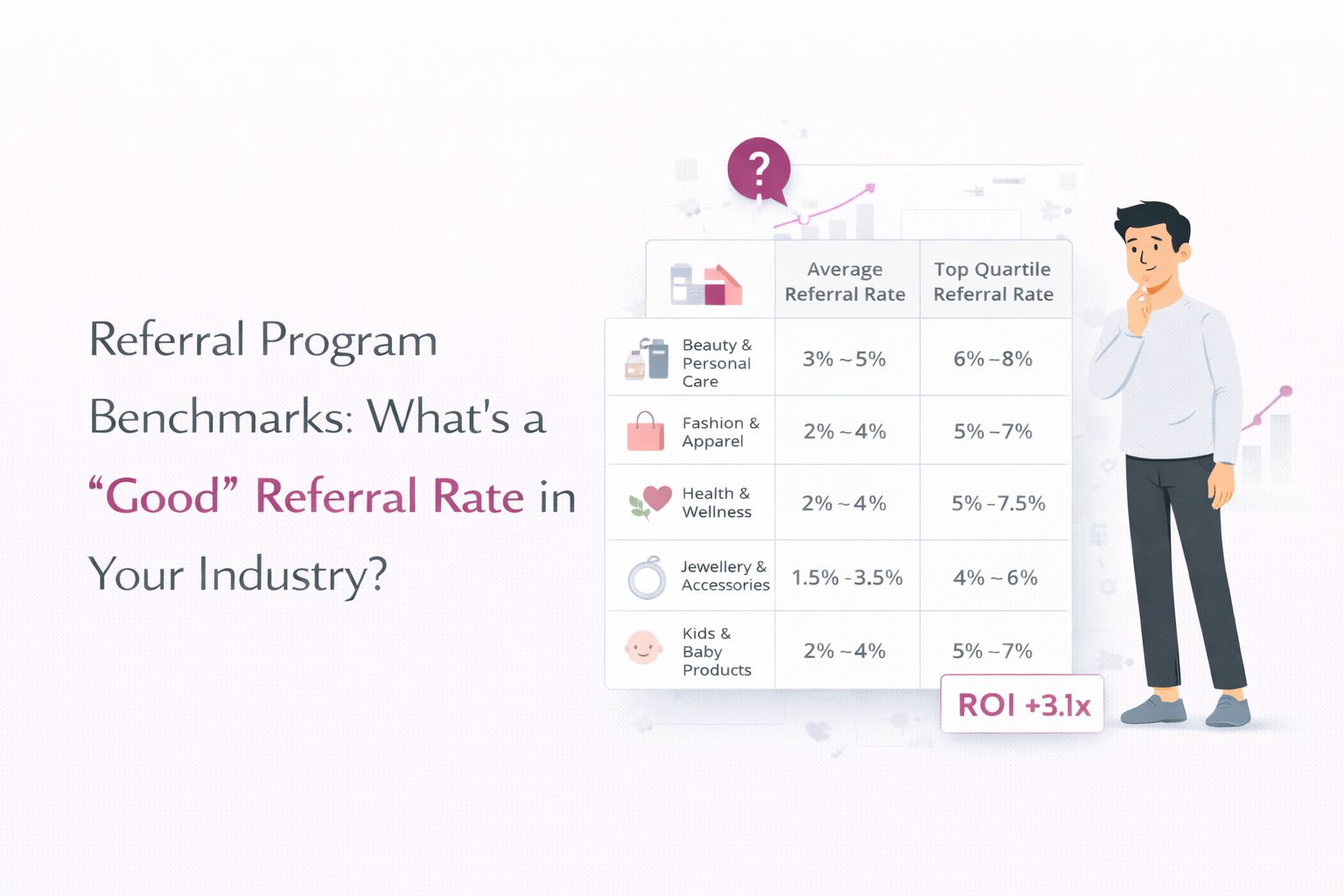
Referral performance varies by industry and average order value (AOV). Below are typical benchmarks for D2C brands with AOVs between ₹500–₹3,500 (roughly $6–$40). If you sell in dollars at a higher AOV, use them as a starting point and compare against your own baseline:
| Industry Vertical | Average Referral Rate | Top Quartile Referral Rate |
|---|---|---|
| Beauty & Personal Care | 3% – 5% | 6% – 8% |
| Fashion & Apparel | 2% – 4% | 5% – 7% |
| Health & Wellness | 2.5% – 4.5% | 5% – 7.5% |
| Jewellery & Accessories | 1.5% – 3.5% | 4% – 6% |
| Kids & Baby Products | 2% – 4% | 5% – 7% |
Top Quartile Referral Rate denotes the performance of the leading 25% of programs in each industry.
Knowing these benchmarks helps set realistic goals and spot underperformance early. For example, a 3% referral rate in beauty & personal care is solid, but if you’re in the top 25%, you’re driving above 6%—a powerful competitive edge.
How do you measure your referral rate?
- Count Referred Orders: Log every order placed with a referral link or code, from widgets, email, SMS, or WhatsApp.
- Count Total Orders: Use total orders for the same period as the denominator, and track invitations sent alongside to see your share and conversion rates.
- Use Automated Reporting: Leverage referral analytics (e.g., Shopify + referral app) for real-time metrics.
- Normalize for Return Windows: Only count referrals after the return window closes to avoid inflated rates.
Regularly monitor these numbers and compare against monthly or quarterly benchmarks. Visual dashboards can highlight trends and seasonality, enabling you to iterate quickly.
How can you improve your referral rate?
1. Optimize Incentive Structures
- Balance Value: Offer win–win rewards (e.g., 10% off for your friend, ₹100 in your pocket).
- Tiered Rewards: Increase rewards for multiple referrals to motivate power users.
2. Simplify the Referral UX
- Prominent Widgets: Place referral calls-to-action on thank-you pages, account dashboards, and email footers.
- One-Click Sharing: Enable sharing via WhatsApp or SMS with pre-filled, personalized messages.
3. Leverage Social Proof
- Showcase live referral activity (“Alex in Mumbai just referred a friend!”) to build FOMO and legitimacy.
- Embed customer testimonials near “Refer & Earn” buttons highlighting real cashback success.
4. Segment and Personalize Outreach
- High-Value Customers: Target frequent purchasers with exclusive referral perks.
- Lapsed Customers: Re-engage with reactivation incentives and gentle reminders.
5. A/B Test and Iterate
- Test different incentive levels, messaging, and widget placements.
- Analyze results and double down on top-performing variants to incrementally raise conversion rates.
Conclusion
Referral rate benchmarks provide valuable context for evaluating and improving your program’s effectiveness. By comparing your performance to industry standards, measuring accurately, and applying data-driven optimizations—like balanced incentives, seamless UX, and social proof—you can elevate your referral rate from average to exceptional.