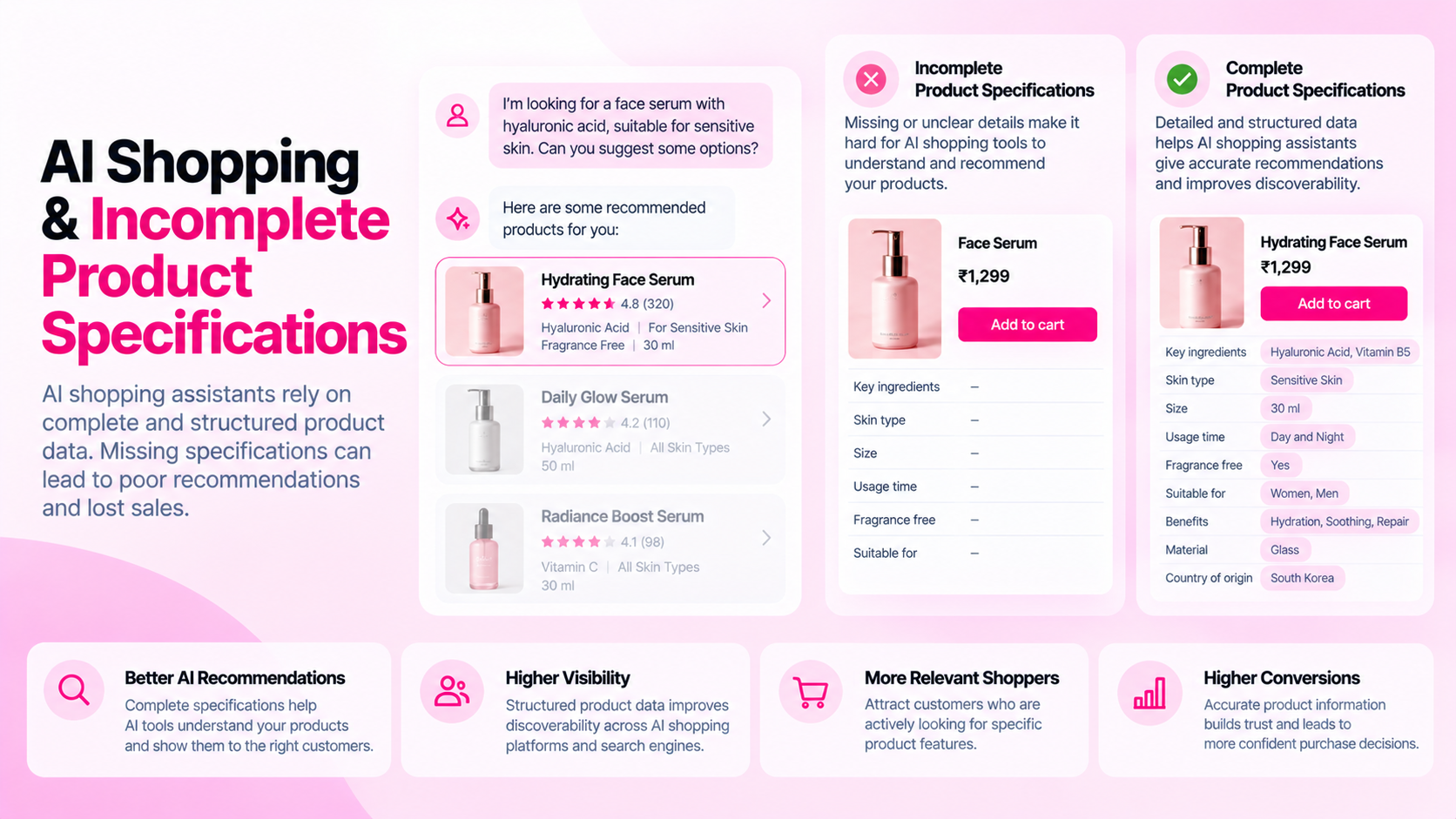
Quick Answer: Why Does Product Data Matter for AI Shopping?
Product comparison — whether by a shopper, a comparison engine, or an AI assistant — depends on accurate, relevant attributes. If size, material, compatibility, dimensions, or other key details are missing or inconsistent, any system has less reliable information to work with. Better data supports clarity but does not guarantee inclusion or recommendation by any specific AI system.
What Counts as a Product Specification?
Specifications are the factual, category-specific attributes that describe a product in terms a buyer can act on. They are distinct from narrative descriptions:
- A product description might say: "Crafted from premium materials for all-day comfort"
- A product specification says: "Material: 87% Merino wool, 13% nylon; Weight: 180g/m²"
Specifications are the facts. They vary significantly by category:
| Category | Key specifications |
|---|---|
| Apparel | Material composition, care instructions, fit type, size range |
| Footwear | Size scale, width, heel height, weight per shoe |
| Electronics accessories | Compatibility (device, OS, connector), power input/output, dimensions |
| Beauty & skincare | Key ingredients, INCI list, volume, SPF rating, skin type suitability |
| Home goods | Dimensions (H × W × D), weight capacity, material, assembly required |
| Food & supplements | Serving size, key nutrients, dietary certifications, volume/weight |
The specifications that matter are the ones a buyer considers when choosing between products in the same category. If a shopper is comparing two running shoes, weight per shoe and sizing scale matter. If they're comparing two serums, ingredient concentration and skin type suitability matter.
How Incomplete Data Affects Comparison
AI shopping assistants and comparison tools work with the information they can access. When information is missing or inconsistent, the comparison degrades in predictable ways:
Missing attribute: A shopper asks "which of these two running shoes is lighter?" If one shoe lists weight and the other doesn't, the tool cannot make the comparison — it may guess, caveat heavily, or simply skip the missing product.
Inconsistent units: Product A lists weight as "280g per shoe". Product B lists weight as "19.6 oz per pair". These are the same weight, but a comparison system that doesn't convert units may treat them as incomparable or incorrectly rank one as heavier.
Conflicting values: A product's description says "100% cotton" but a metafield says "cotton blend". A system reading both fields encounters a contradiction and must either pick one or flag it as unreliable.
Buried specifications: Key attributes mentioned in a paragraph of descriptive copy ("This lightweight jacket, weighing just 280 grams, is designed for...") are harder for machine parsing than a structured specification field explicitly labeled "Weight: 280g".
Build Category-Specific Attribute Sets
The practical fix is to define required specifications per product category — not a universal list applied to all products:
- Pick a category: Start with your highest-revenue product type or the one with the most complex buying decision
- Identify the decision attributes: What does a shopper compare when choosing between two products in this category? These become required fields
- Define the format: Choose one unit, one naming convention, one data type per attribute
- Apply to the category in Shopify: Use metafields (for structured storage) and ensure they're rendered on product pages (for visibility)
- Audit completeness: Identify which products in the category have missing or inconsistent values
A generic attribute checklist applied to all products produces noise — irrelevant fields populated with "N/A" and missing fields where they actually matter.
Keep Data Consistent Across the Storefront
The same specification may appear in multiple places — the product description, a metafield, a structured data block, and a product feed. When these sources disagree, systems must choose which to trust, and shoppers see contradictory information.
To maintain consistency:
- Define one source of truth per attribute (description body vs. metafield)
- When an attribute changes (reformulation, updated specs), update all representations simultaneously
- Audit periodically for products where description and metafield values have diverged
A quarterly audit of a sample of products per category — comparing what's in Shopify Admin against what renders on the storefront and what's in the feed — is a practical cadence for most stores.
What This Does and Does Not Guarantee
Structured, accurate product specifications improve the information available to shoppers and systems. Being specific about what this achieves:
It supports:
- Shoppers making informed comparisons without guessing
- Search engines understanding what the product is and who it's for
- Feed platforms receiving accurate attribute values for filtering and category matching
- AI systems having structured data to work with
It does not guarantee:
- That a specific AI shopping assistant will include the product in its results
- That the product will be recommended or ranked in any particular way
- That all systems will crawl, parse, or use the structured data correctly
- That better data will produce specific ranking or conversion outcomes
The honest framing: complete, accurate, consistent product data removes barriers that incomplete data creates. Whether those barriers were the primary obstacle for any specific outcome depends on many other factors.
Frequently Asked Questions
Does AI read every Shopify product page? No. AI shopping assistants and comparison tools vary in how they access product information — some crawl pages, some use submitted feeds (Google Merchant Center, Meta Catalog), some use licensed product databases. There is no universal access model. The pages that are well-structured with accurate specifications are generally better served by any access method.
What attributes should be included? Include accurate fields relevant to the category and the customer's actual buying decision. Don't add fields because they seem comprehensive — add fields that a shopper would consider when comparing two products in this category.
Does adding schema markup guarantee AI visibility? No. Schema markup (JSON-LD) makes structured product data machine-readable in the page source. Whether a specific AI system reads it, uses it, or includes the product in its results depends on the system's policies, access methods, and relevance criteria.
Is there a minimum viable attribute set that works across all categories? A title, price, availability, primary image, and a brief accurate description are a baseline for every product. Beyond that, the required attributes are category-specific. Apparel needs material and sizing; electronics need compatibility; beauty needs ingredients. There is no universal minimum that serves every category well.
Related Articles
- Can AI Shopping Assistants Read Your Shopify Product Variants Correctly?
- How to Structure Product Attributes for Accurate Product Comparisons
- Shopify Metafields vs Product Descriptions: Where Should Product Specifications Live?