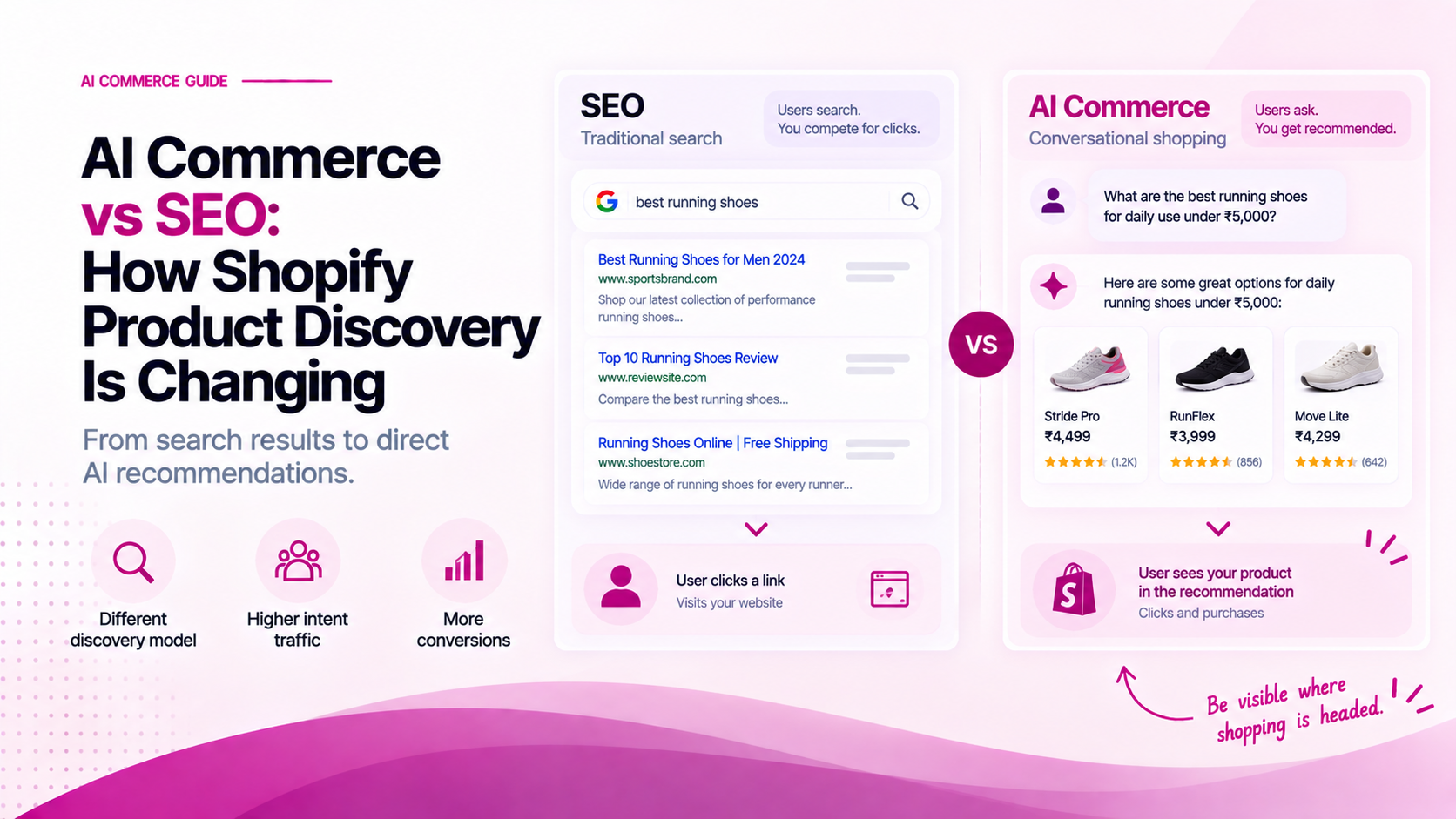
For the past twenty years, e-commerce discovery has operated on a single core model: Search Engine Optimization (SEO).
The merchant's goal was clear: optimize keywords, build backlinks, satisfy search intent, and rank on page one of Google for target queries.
AI-assisted shopping introduces a fundamentally different model: Generative Recommendation & Agentic Discovery.
Understanding how these two models differ—and how they work together—is essential for maintaining organic brand discovery.
Direct Comparison: SEO vs. AI Commerce
Discovery Evolution
├── Traditional Search (SEO)
│   └── User Query ──> Index Crawler ──> Ranked 10 Blue Links ──> User Clicks PDP
└── AI-Assisted Shopping
    └── User Query ──> Agent Evaluation ──> Synthesized Recommendation ──> Direct Action / Cart
| Strategy Dimension | Traditional E-Commerce SEO | Generative AI Commerce |
|---|---|---|
| Primary Goal | Rank high on Search Engine Results Pages (SERPs) | Get included in AI recommendations & answer shortlists |
| User Query Format | Short keywords ("men running shoes") |
Conversational intent ("best cushioned road shoe for wide feet under ₹8,000") |
| Index Mechanism | Web crawlers indexing keywords & backlink graphs | LLM retrieval-augmented generation (RAG) & real-time API feeds |
| Winning Factor | Domain authority, keyword density, backlinks | Attribute completeness, product spec accuracy, trust signals |
| Conversion Journey | Click link → Land on PDP → Browse → Checkout | AI evaluates candidates → Synthesizes comparison → Direct purchase |
1. From Keyword Matching to Intent Resolution
Traditional search engines match input keywords against page headings and body text. If a user searches for "durable leather backpack", Google returns pages containing those exact phrases and related synonyms.
AI shopping engines perform intent resolution. When a buyer asks:
“I need a professional bag for daily commute that fits a 16-inch laptop and won't ruin my suit jacket”
The AI agent breaks down the query into specific operational criteria:
- Category: Backpack / Messenger Bag
- Capacity constraint: Fits ≥16-inch laptop dimensions
- Material constraint: Smooth straps / non-abrasive back panel (won't ruin suit fabric)
- Style context: Professional / Minimalist aesthetic
If your store only provides generic marketing text ("a stylish bag for modern professionals"), the AI agent cannot confirm whether it fits a 16-inch laptop or if the straps are non-abrasive. The product is passed over in favor of a competitor that lists explicit measurements.
2. From SERP Rankings to Inclusion Metrics
In SEO, position matters above all else—position #1 gets ~30% of clicks, while position #10 gets ~2%.
In AI-assisted shopping, there is often no 10-blue-links page. The AI assistant presents:
- A single top recommendation with explicit rationale
- A comparative shortlist of 2–3 categorized options
- A dynamic table comparing specifications across brands
AI Recommendation Output Example:
"Based on your requirements, here are the top 2 options:

1. Option A (Best for Durability): 100% Cordura nylon, 25L capacity, padded 16-inch laptop sleeve.
2. Option B (Best Premium Leather): Full-grain Italian leather, smooth back panel to protect clothing."
The key metric shifts from SERP Position to Inclusion Rate (how often your product appears in relevant AI shortlists).
3. The New Organic Hybrid Strategy
AI commerce does not replace SEO; it builds upon it. Web crawlers and AI retrieval systems rely on the same underlying foundation: clean, accessible, structured web data.
How to execute a Hybrid Organic Strategy:
- Maintain Technical SEO Fundamentals: Ensure fast page load times, clean URL structures, mobile responsiveness, and XML sitemaps.
- Expose Rich Metafields & Microdata: Use Shopify Custom Data to store machine-readable product attributes.
- Publish Fact-Dense Content: Write comprehensive FAQ sections and specification tables on every product page.
- Build Ecosystem Trust: Encourage customer reviews on verified platforms that export structured schema.
Key Performance Indicators for AI Discovery
As search behavior evolves, track these metrics to evaluate your store's AI readiness:
- AI Referral Traffic: Track visits originating from AI domains (
chatgpt.com,perplexity.ai,claude.ai). - Brand Share of Voice (SoV) in AI Prompts: Benchmark how often your brand is recommended for top 50 category queries.
- Data Completeness Index: Percentage of active SKUs with 100% completed standard taxonomy attributes.
Related Articles
- How to Make a Shopify Product Catalog AI-Ready
- What Product Data Do AI Shopping Agents Need?
- How to Track AI-Referred Traffic to Shopify