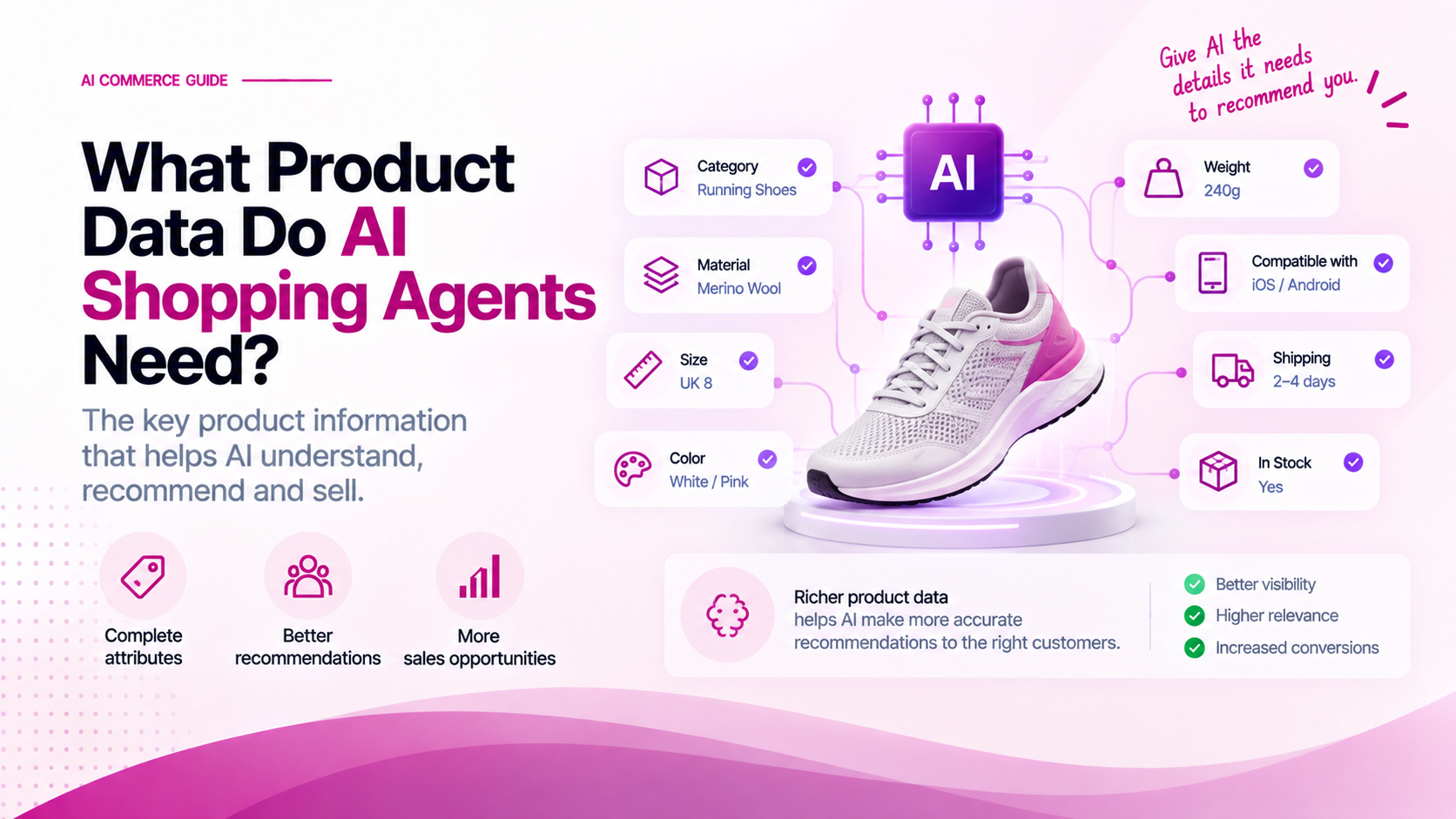
When an AI shopping agent processes a user request like:
“Find me a lightweight waterproof jacket under ₹6,000 for high-altitude trekking in cold weather”
It evaluates candidates across multiple dimensions simultaneously. Unlike traditional search engines that rely on string matching, AI agents execute attribute extraction, constraint matching, and comparative trade-off analysis.
To participate in these automated recommendation engines, merchants must understand the specific data attributes required by AI shopping systems.
The 10 Core Questions AI Agents Ask About Every SKU
When analyzing a product page or feed, an AI shopping agent seeks clear answers to ten fundamental questions:
- Identity: What exact product type and sub-category is this?
- Target Persona: Who is the intended user (gender, age group, experience level, skin type, fit)?
- Primary Use Case: What specific problem or activity does this product solve?
- Differentiator: What specific feature sets it apart from direct alternatives?
- Technical Specs: What are the numerical and qualitative specifications (weight, dimensions, power, materials)?
- Commercial Terms: What is the current price, sale price, currency, and stock availability?
- Variant Breakdown: What variations exist (sizes, colors, bundles, capacities)?
- Fulfillment Logistics: Where can it be shipped, how fast, and at what cost?
- Risk Mitigation: What is the return policy, warranty duration, and money-back guarantee?
- Social Evidence: What is the aggregate rating, review count, and sentiment summary?
Category-Specific Data Matrices
Different product categories require fundamentally different attribute sets. Generic product descriptions fail because they omit category-critical decision variables.
1. Fashion & Apparel Matrix
Apparel Product Attributes
├── Fabric Composition: 100% Organic Cotton
├── Fabric Weight: 220 GSM (Heavyweight)
├── Fit Type: Oversized / Boxy Fit
├── Care Instructions: Machine wash cold, line dry
├── Layering Role: Outer Shell / Mid-Layer
└── Sizing Guide: Fits true to size; model is 6'0" wearing Size L
| Required Attribute | Field Type | Why AI Agents Need It |
|---|---|---|
material_composition |
Text | Evaluates durability, breathability, and eco-credentials |
fit_type |
Choice | Answers customer fit preferences (slim, relaxed, oversized) |
care_instructions |
List | Answers maintenance questions (dry clean only vs machine wash) |
size_matrix |
Object | Verifies exact stock availability per size variant |
2. Beauty & Skincare Matrix
Skincare Product Attributes
├── Active Ingredients: 2% Salicylic Acid, 1% Zinc PCA
├── Target Skin Type: Oily, Acne-Prone, Sensitive
├── Formulation: Water-Based Gel Serum
├── Free-From Claims: Fragrance-Free, Paraben-Free, Cruelty-Free
└── Usage Frequency: Daily (Morning & Evening)
| Required Attribute | Field Type | Why AI Agents Need It |
|---|---|---|
active_ingredients |
List | Matches specific skin conditions and customer ingredient filters |
skin_type_compatibility |
List | Prevents recommending harsh products for sensitive skin |
formulation_type |
Text | Matches texture preferences (lightweight gel vs rich cream) |
fragrance_status |
Boolean | Essential for allergy-conscious and sensitive skin queries |
3. Consumer Electronics Matrix
Electronics Attributes
├── Battery Capacity: 5000 mAh (up to 18 hours playback)
├── Connectivity: Bluetooth 5.3, Wi-Fi 6E, 3.5mm Aux
├── Compatibility: iOS, Android, macOS, Windows 11
├── Water Resistance Rating: IPX7 (Waterproof up to 1m)
└── Charger Input: USB Type-C (Fast Charging 30W)
| Required Attribute | Field Type | Why AI Agents Need It |
|---|---|---|
compatibility |
List | Validates hardware ecosystem fit (e.g. works with iPhone 15) |
ip_rating |
Text | Answers environmental protection requirements (IP67, IPX4) |
battery_life_hours |
Number | Allows numerical comparisons against competing devices |
warranty_years |
Number | Evaluates product longevity and risk profile |
Marketing Language vs. Machine-Readable Specs
AI agents filter out subjective marketing fluff and extract verifiable specifications.
❌ MARKETING FLUFF (Ignored during hard constraint matching):
"Engineered with revolutionary ultra-dry technology to keep you feeling incredible all day long."

Value: 0 actionable attributes extracted.

---

✅ STRUCTURED MACHINE DATA (Matched immediately against user queries):
- Waterproof Rating: 20,000mm HH
- Breathability Rating: 15,000 g/m²/24hr
- Seam Construction: Fully Taped Seams
- Shell Fabric: 3-Layer Ripstop Nylon

Value: 4 hard attributes extracted and verified.
Handling Constraints & Negative Eligibility
Negative constraints are just as important as positive features. Stating explicit exclusions prevents bad recommendations, reduces return rates, and builds buyer trust.
Examples of useful negative signals:
- Compatibility Exclusion: "Not compatible with pre-2020 MacBook Pro models"
- Usage Exclusion: "Not suitable for sensitive or broken skin"
- Shipping Exclusion: "Cannot ship express to PO Box addresses"
- Sizing Restriction: "Runs small; order one size up for a comfortable fit"
How to Audit Your Top 20 SKUs
To verify whether your key revenue drivers are AI-agent ready, perform this audit on your top 20 SKUs:
- Extract Product Data: Copy all text and structured metafields for the SKU.
- Run 10 Intent Queries: Prompt an AI model (e.g. "Should I buy [Product Name] for [Specific Intent]?").
- Evaluate Output Accuracy:
- Did the model correctly state materials, dimensions, and compatibility?
- Did it guess or hallucinate any missing details?
- Did it accurately convey stock status and pricing?
- Remediate Missing Fields: Add missing attributes into Shopify Admin category fields or custom metafields.
Related Articles
- How to Make a Shopify Product Catalog AI-Ready
- How to Optimize Shopify Product Pages for AI Shopping
- How to Check Whether AI Can Understand Your Shopify Products